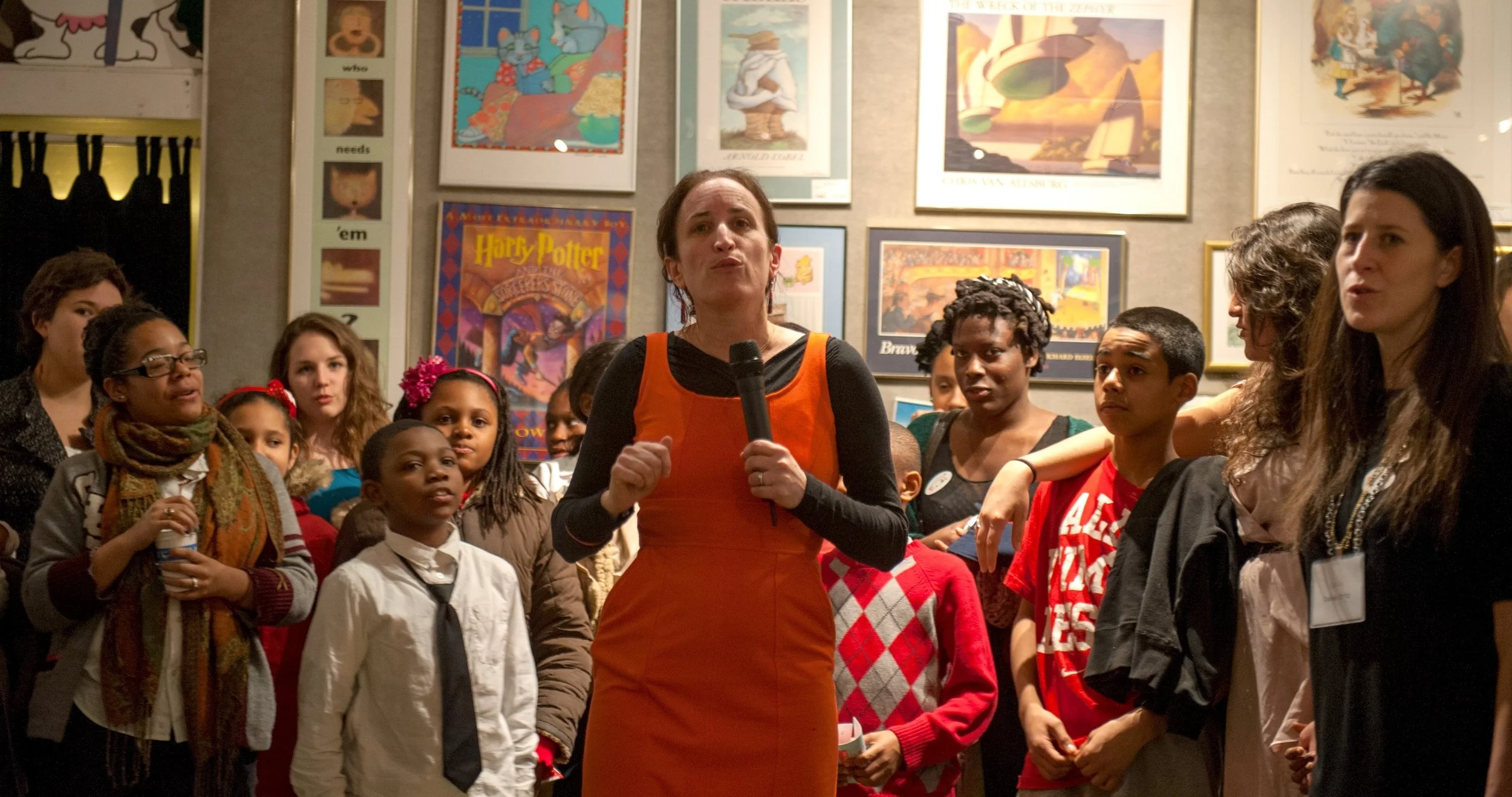
Speaking at Teachers College April 12

Posted April 5th, 2010 by admin and filed in Uncategorized
1 Comment

If you’ll be in New York City next Monday afternoon, come to this talk at Teacher’s College!

Pam Allyn at Teachers College Pam Allyn M.A. ‘88 Speaks at Teachers College
Monday, April 12th, at 3:00 PM in
179 Grace Dodge with a reception to follow

Sponsored by the Office of Student Activities, the Vice President’s Office of Diversity and Community Affairs, the Committee for Community and Diversity, and the Office of Alumni Relations.

Click Here to RSVP!

World Read Aloud Day is TOMORROW!

Posted March 2nd, 2010 by pamallyn and filed in LitWorld, Press
Tags: , , , , , , , , ,
Comments Off

Get PSYCHED by reading my new post on Psychology TodayStorytelling Connects Us All!

Tune into Oprah Radio on Sirius Satellite Radio tonight at 5pm EST to hear me on The Dr Laura Berman Show!

Check out World Read Aloud Day in the New York Times with awesome recommendations – Great Read Alouds From The New York Times by Katherine Schulten!

And watch World Read Aloud Day’s San Francisco representation on The View From the Bay!

It’s not too late to find a way to participate in LitWorld’s First World Read Aloud Day, our global celebration of reading and the power of story that will be taking place all over the world all day tomorrow, March 3!

For tips and recommendations and inspiring special projects check out litworld.org/wrad. You can simply read aloud with a loved one, celebrate online with status updates on Facebook or Twitter that include “#WRAD litworld.org” and your favorite read-aloud title or memory, write a post on your website or blog, or join in a community event, whatever suits your day!

One voice can change the world, but together our voices can truly transform the world for all children, everywhere.
Don’t forget to register and let us know what action you take, large or small!
Pam

What We Carry

Posted February 18th, 2010 by pamallyn and filed in LitWorld
Tags: , , , , , ,
Comments Off

Last week, two of my colleagues came to my house and prepared materials for the children and teachers I have been visiting in Kenya this week: beautiful books donated by Scholastic, school supplies we’ve collected, leaving room for the gifts being brought over later by teachers from the Bronxville school: story strings made by teachers for teachers as well as teaching supplies so desperately needed in Africa.

It all made me think again about the things we carry and how we prepare for our journeys. I brought very few clothes and assorted extras and used every available space for the gifts that have the potential to transform a teacher and inspire a classroom. As always, it’s been an extraordinary and joyful process and I have been so thrilled and rewarded to see the community of the Red Rose School again.

Some time ago I talked with my LitLife colleagues about what’s in our bags. We talked about what we pack when we go to schools. We had some good laughs over this: our crunchy granola bars, that book we can’t let go, the secret stash of chocolate for that two p.m. lag, the essential LitLife documents and a memory stick.

But there’s plenty more to go into those bags. And plenty more to leave out. What do we choose to carry?

Here’s what I hope we all carry when we share education and literacy:
- Core Values:  Collaboration, Dignity, Equity, Responsiveness, Reflection, Innovation.
- Inspiration:  Ignite the fire of others and honor even the smallest steps with grace.
- Content:  The juice! Actual evidence of work you’ve done to prepare… bring the gifts, the lessons, that will change lives. Take time for preparedness.

You don’t really need to pack much, but you need to pack wisely. With that, what I saw in watching my colleagues so carefully make sense of all that should and could go in my bags for this trip was an essential collaboration. I could not make this journey without them, and even just the joy in sharing the experience of that became part of what I took with me on this journey

A final set of reflections:
- Let your colleagues inspire you. Reach out to them. Let them help you. Be there to help them.
- Pack your bags wisely and well. (Don’t pack too heavy; bring enough to share).
- Arrive with gifts. (Let people know you care).

I look forward to sharing with you soon stories of the amazing visit I’ve had to Kenya this week with the incredible children and my inspiring Kenyan colleagues. My journey is drawing to a close today, as I repack my bags now to head towards home (with a quick stop in Illinois to give a talk tomorrow morning).

I hope you are now preparing your bags for our trip together around the globe on March 3 for World Read Aloud Day. Even if you are simply participating by spreading the word online, the words you choose to share on and for that day will show the world what you carry and how you carry it.

With joy,
Pam

Lessons from Mrs. Kovacs: What is Teacher Effectiveness and How to Measure It?

Posted January 27th, 2010 by pamallyn and filed in Education
Tags: , , , , , , , ,
Comments Off

A few months ago, President Obama and Education Secretary Arne Duncan announced the Race to the Top Fund for Education. Key elements to receiving some of the allocated four billion dollars are the recruitment, development, reward and retention of effective teachers.

This requirement poses a confounding conundrum. How is it possible to measure something or someone whose value cannot be entirely proven or seen for sometimes years after the first impact is felt?

As a teacher educator for the past two decades, I see administrators struggling with this dilemma. For while test scores tell part of the story, they by no means tell it all. An effective teacher is an amalgam of coach, supporter, knowledge bearer, information sharer, community builder, reader, writer, mathematician, wise seer and humorist. We’ve all seen and known effective teachers, but when it comes to assessing qualities, the essence of an effective teacher is maddeningly hard to pin down.

Mrs. Kovacs was my third grade teacher. Each student was the beneficiary of her many gifts. My reading level was high, but I was shy. My classmate Robert was social, but his painful secret was that he could not read. While Mrs. Kovacs helped me write my first “novel” in her class (“Thunder: A Horse”; a thinly veiled homage to Black Beauty), Robert read a sentence for the first time. I read my story aloud that year, the first time most of my classmates ever heard my voice. Robert learned to read books independently. She expressed joy in our successes, and an intuitive understanding of what each of us needed.

Each of us can recite the names of our favorite teachers from childhood. Those from whom other teachers could learn and emulate. By whose example the child’s life is forever touched.

The child’s own test data won’t tell that whole story, the story of all those tomorrows.

Teaching is, after all, a deeply human endeavor. It is hard work alongside children with complex lives, to nurturing them equally and profoundly, both intellectually and emotionally. The elusive qualities that add up to lifelong success belong on the assessment grid too. So young teachers entering the field have a more specific road map for their own successful journey. So longtime teachers can change course if necessary to fulfill their professional responsibilities.

I propose Six Standards for TE (Teacher Effectiveness) Measurement that would be used in addition to the students’ standardized test data in identifying and assessing the qualities of a truly effective teacher. The teacher him or herself would be assessed by a combination of administrators, peers and students.

Professionalism
Reads professional books and visits relevant websites, receives ongoing training, participates actively in on site professional development opportunities: mentors other teachers, receives mentoring willingly and openly. Assessment rubrics conducted by administrators and through a peer review.

Knowledge
Builds on curricular knowledge through ongoing professional development opportunities, online and otherwise, refreshes knowledge constantly. Is open to technology and incorporates it into classroom practice. Assessment rubrics conducted by administrators and students.

Humanity
Relates to children, creates an atmosphere of learning and peace in the classroom. Assessment rubrics conducted by students (or if K-2, interviews of students by administrators) and in observations by administrators using assessment rubrics.

Inspiration
Motivates students on a daily basis. Assessment rubrics completed by students.

Management
Classroom environment reflects active learning; rigorous and collaborative environments are structured and organized; time is managed well and there is a clear understanding of use of time and what is being taught within those time frames. Assessment rubrics conducted by administrators and peers.

Discipline
Creates and enacts structured lessons, lessons are part of an articulated vision of the desired outcomes for the year; each week is formally organized and can be clearly understood by students. Assessment rubrics conducted by administrators and peers.

Recently, I called my old school district to find out if I could thank Mrs. Kovacs. I was told she had only taught for two years before she was killed in a car accident. A day later I received a call from the school. They told me that within that same week I had called, a man, another former student, had also called asking about her. Since she’d only taught those two years, they thought I’d appreciate the coincidence. But they didn’t know his name. My guess is that it was Robert.

In The Huffington Post – Bedtime Reading

Posted January 25th, 2010 by admin and filed in Press
Tags: , , , , , , , , ,
Comments Off

Pam’s second article for The Huffington Post has just been published, check it out!

Bedtime Reading: Children’s Stories To Inspire You In Your Sleep…

Pam Now on “Psychology Today”

Posted January 14th, 2010 by admin and filed in Press
Tags: , , , , , , , ,
Comments Off

Pam Allyn is a new featured blogger for the renowned website, “Psychology Today,” check out her first post!

THE VALUE OF A PICTURE BOOK: 5 Life-Lessons Your Child Gets From Stories

A Lit Life

Posted December 31st, 2009 by pamallyn and filed in Family
Tags: , , , , ,
Comments Off

It is my wish in this new year to inspire your journeys of warmth, hope, and the glow of the blessings of childhood, of teen years, of what your communications with children can bring to YOU.

As parents, educators, grandparents and caregivers, so much of the way we think of our caretaking is in terms of what WE can do for those for whom we care. But in truth, the lessons of childhood are for us all. The lessons of teenhood. Somewhere inside each of us is that same person we always were. Inside that teenager is the same baby who tilted her head towards you in the first days after birth. We walk around with our hearts pounding for the sheer joy, worry and excitement of life. A Lit Life is a life enriched by children, by the raising of, teaching of, children who influence us, are our greatest teachers. They light us from within. I will in this new year explore the terrain of learning to read, reading to learn, the new technologies which will transform how we understand what it means to communicate, to write, to “only connect”, as EM Forster said.

Today’s learnings:

1. The most perfect gifts are made by nature.

Charlotte with Garlic

Charlotte, beloved daughter, holds up a perfect luminous garlic from her Aunties’ garden. Like an orb from another planet, its translucence is transcendent.

2. We are never too old to play.

Grandma's Stocking Gifts

Grandma still makes a stocking for her granddaughters at the holiday season.

3. Attention to details matters.

Grandpa's Cookies

Grandpa takes his time with his cookies. They are a work of art and delight each and every year.